Sea salt and aquatic accords are one of the more forgiving families for a vegan-positioned brand, because the marine effect is built from synthetic aroma chemicals rather than from anything taken from an animal. That makes them a sensible place to start. The difficulty is not the smell; it is the documentation behind the claim, and a brief specific enough that the perfumer does not reach for a musk or amber base you cannot declare.
Key takeaways
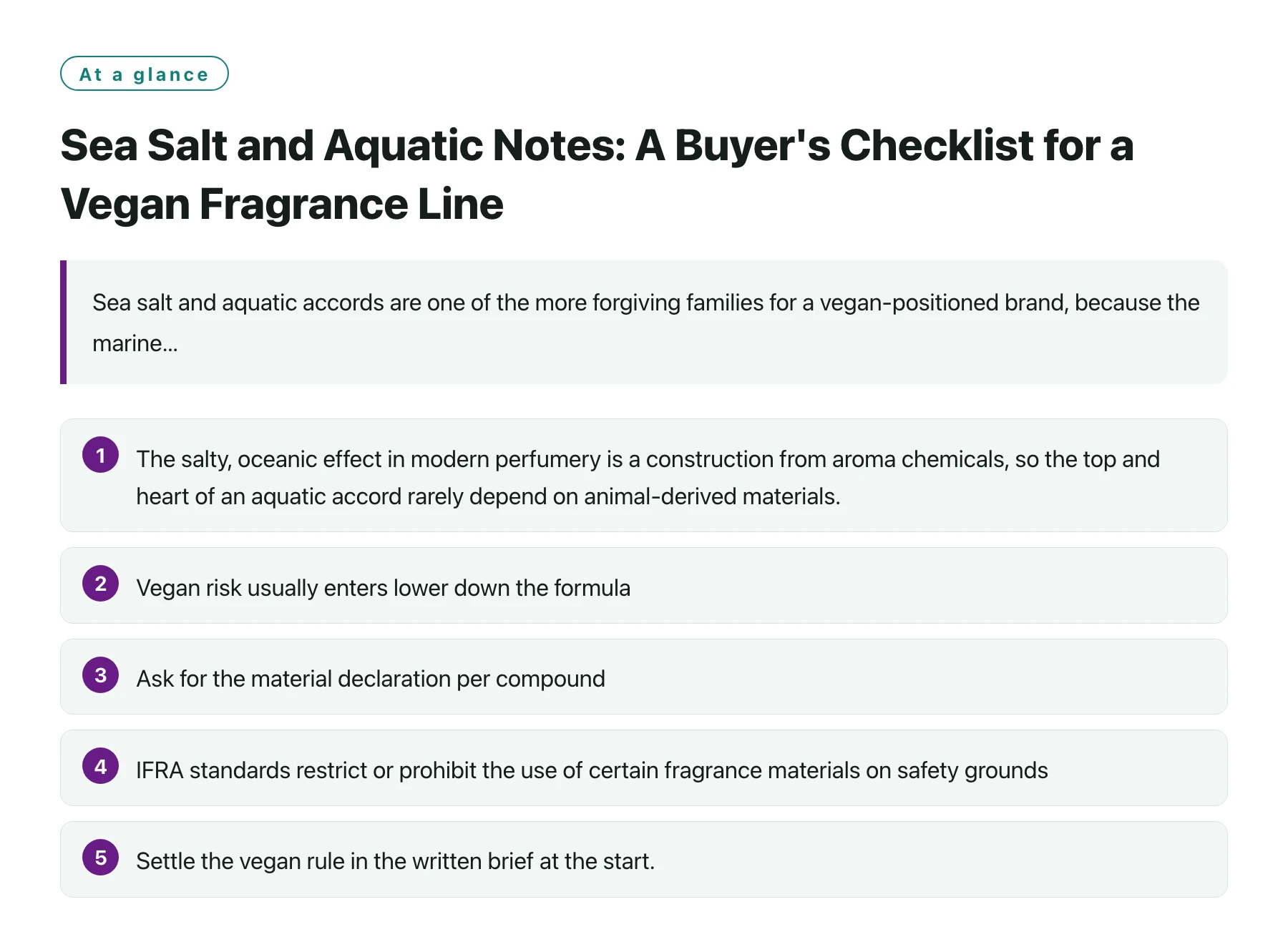
- The salty, oceanic effect in modern perfumery is a construction from aroma chemicals, so the top and heart of an aquatic accord rarely depend on animal-derived materials.
- Vegan risk usually enters lower down the formula, through musk, ambergris-type, honey, beeswax or leather accords rather than through the marine note itself.
- Ask for the material declaration per compound, not a single sentence stating that the finished fragrance is vegan; a claim without a list behind it cannot be checked.
- IFRA standards restrict or prohibit the use of certain fragrance materials on safety grounds, so a vegan brief and a compliant brief are two separate requirements that both have to be met [1].
- Settle the vegan rule in the written brief at the start. Adding it after the first submission normally means rebuilding the base rather than adjusting the top.
Brands coming from skincare or food often assume that a vegan fragrance is mostly a marketing decision. In practice it is a specification decision. Someone has to write down which material families are excluded, and someone has to be able to show, per compound, that the finished formula contains none of them.
Aquatic and sea salt themes are a good first project because the answer is usually already on the right side of the line. The catch is that the same formula that smells like open water also needs a base to hold it together, and the base is where the classic animal-derived materials live.
What follows is a working checklist: where the accord comes from, what to ask for, and how to keep the claim defensible once the product is on a shelf in three different markets.
Why marine accords are a friendly brief for an animal-free line
A modern marine accord is assembled from aroma chemicals that produce salty, ozonic, melon-like and watery effects: dihydromyrcenol for the fresh-air quality, Calone-type materials for the melon-and-sea-breeze signature, Helional and similar aldehydes for the airy lift. None of those are animal-derived, and none of them require an animal to produce. That is true of the great majority of what a perfumer would use to build the family, which is why sea salt and aquatic themes so often end up on the vegan-friendly side of a portfolio [1].
It is worth understanding how aquatic notes are built before writing the brief, because the construction explains the cost and the lead time as much as the smell does. Marine accords are usually built around a small number of high-impact materials dosed at very low levels, which keeps the concentrate affordable but makes the formula sensitive to small changes.
The salty effect is a construction, not an ingredient
There is no single sea salt raw material. Saltiness is suggested by a combination of mineral, ozonic and slightly metallic notes that the brain reads together as salt air. That is useful for a vegan brief, because it means the accord can be rebuilt from a different set of materials if one of them is excluded for any reason.
Where animal materials usually sit
Historically, fine fragrance leaned on animal-derived materials for depth and fixation: ambergris from sperm whales, natural musk from musk deer, civet and castoreum. Modern perfumery replaced most of them decades ago with synthetic equivalents such as ambroxan and macrocyclic musks. The replacements are widely used and well documented, but a formula written without a stated vegan rule can still include beeswax absolute, honey accords, lanolin derivatives or a leather note built on animal-derived tinctures.
A checklist to run before the first submission
- Write the exclusion list, not the labelState which material families are out: animal musks, ambergris and its natural sources, civet, castoreum, beeswax, honey, lanolin, carmine and animal-derived glycerin. A perfumer can work with a list; 'make it vegan' is not a workable instruction.
- Ask for the material breakdown per compoundA finished-fragrance statement is a conclusion. The useful document lists every compound in the formula with its declared materials, so the claim can be checked line by line rather than trusted.
- Separate vegan from naturalThese are different positions. A natural material can be animal-derived, and a synthetic material is often the vegan choice. Brands that confuse the two end up excluding the very materials that would make the claim easy to support.
- Interrogate the fixativeMarine top notes fade quickly, so the base carries the wear. Ask which fixative family is used and whether it contains any animal-derived component, then test on skin at the dosage you will actually sell.
- Decide who owns the claimThe factory can supply the material data; the brand owns the public claim. Agree in writing which party keeps the records and for how long, because a retailer or a marketplace can ask for them years later.
- Build the process around [[LINK:custom fragrance R&D and production]] rather than around a single sampleA vegan position has to survive reformulation. A partner that documents each revision makes that survivable; one that treats each sample as a fresh start makes it expensive.
What to ask about each part of the accord
| Part of the accord | What it contributes | Vegan question | Document to request |
|---|---|---|---|
| Ozonic and marine top | The salty, open-air first impression | Is any animal-derived tincture used for lift? | Material declaration per compound |
| Green and citrus heart | Freshness that keeps the marine note from smelling flat | Are the natural extracts standardised with animal-derived carriers? | Carrier and solvent statement |
| Floral middle | Softness and wearability | Were any animal tinctures used historically and replaced? | Substitution note in the formula file |
| Musk and amber base | Longevity and skin fixation | Which musk family, and is any of it animal-sourced? | Base composition summary |
| Colour and additives | Appearance and stability | Any carmine, shellac or animal-derived glycerin? | Additive list with INCI names [2] |
The last column matters more than the third. An answer without a document is a conversation; the document is what survives a change of perfumer, a change of factory or a retailer's audit.
Where a vegan claim gets fragile
Most problems appear at the edges of the project rather than in the accord. A colourant added late to meet a brief for a blue-tinted liquid, a carrier solvent swapped by a supplier, or a decal on the bottle that uses a shellac-based varnish can all undercut a claim that was true of the fragrance concentrate.
Ingredient databases such as the European Commission's CosIng give the official names and functions of cosmetic ingredients, which is useful when checking what a supplier's list actually refers to [2]. It is a reference tool rather than a verdict on your product, but it removes a lot of ambiguity from a material declaration written in trade names.
The practical rule is to extend the vegan specification beyond the juice. Bottle, cap, pump, decoration and any secondary packaging belong in the same document, because that is where the last-minute substitutions happen.
Keep the brief short enough to be used
A fifteen-page specification is rarely read. A two-page brief with the exclusion list, the material documentation requirement and the approval reference is read every time. Manufacturers who handle fine fragrance manufacturing for several markets will normally have a template for exactly this, which shortens the first conversation considerably.
The cheapest moment to fix a vegan specification is before the first submission. Once a base has been approved on smell, changing a musk or a fixative is not a small edit; it moves the drydown, restarts stability testing and usually pushes the launch date. Write the exclusion list first, approve the formula second, and only then judge the scent.
Choosing who builds it
A marine brief is a reasonable test of a supplier, because it asks for both creative range and paperwork. Ask for the material breakdown at quotation stage, not at production stage, and ask which markets the documentation pack is written for. The answer tells you how much of the compliance work you will be doing yourself.
Manufacturers such as Guangzhou Xuelei publish their service scope and certification list openly, which makes the first round of screening faster simply because there is something concrete to compare against. A shortlist of three suppliers, all asked the same written questions, will show more than a week of emailing samples back and forth.
Sources
- IFRA Standards Library (International Fragrance Association) —— The IFRA Standards Library lists the restrictions the fragrance industry applies to individual fragrance ingredients, based on safety assessments; it is the reference point for compliant fragrance formulation.
- EU CosIng — Cosmetic Ingredient Database (European Commission) —— The European Commission's CosIng database of cosmetic ingredients, listing ingredient functions, restrictions and labelling requirements under EU cosmetics law.
Frequently asked questions
Are sea salt fragrances automatically vegan?
No. The marine part usually is, because it is built from aroma chemicals, but the base, any colourant and the bottle decoration are separate decisions. The accord being animal-free does not make the finished product animal-free.
Does vegan mean the same as natural?
No, and the two often pull in opposite directions. Many animal-derived materials are natural, and many synthetic materials are the vegan option. Treat them as two independent specifications with two separate documents.
How do I verify a supplier's vegan statement?
Ask for the material declaration per compound, then check that every listed material is on the right side of your exclusion list. A certificate from a third party is helpful, but the underlying list is what tells you whether the claim is still valid for your formula.
What is the cheapest way to keep the claim safe?
Write the exclusion list before development begins and extend it to packaging and decoration. Retrofitting a vegan rule after the base is approved is the expensive route, because it usually triggers a reformulation and a second round of stability testing.
Do I need a separate formula for a vegan version?
Not necessarily. If the original formula never used an excluded material, the same concentrate can carry the claim. The decision hinges on the material list, not on whether a new formula is written.